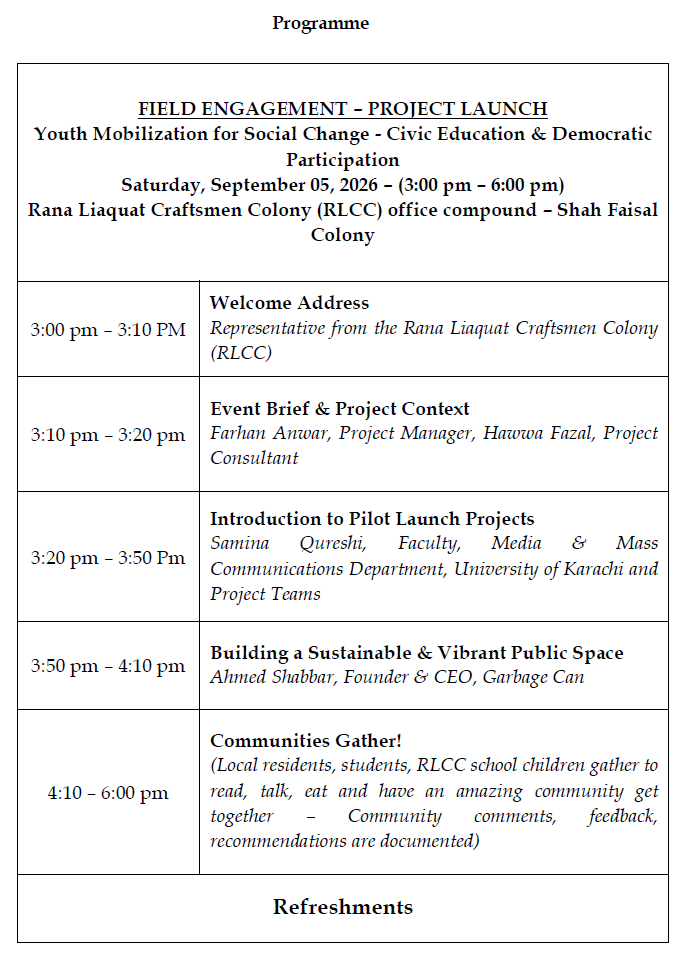
On 5 September 2026, Shehri – Citizens for a Better Environment (Shehri-CBE) organized a field engagement and exposure visit to Rana Liaquat Ali Khan Craftsmen Colony (RLCC), Shah Faisal Colony, Karachi, bringing together students from Habib University, Aga Khan University, and MITE University under Component 2: Democracy Lab – Incubator for Civic Action of the Youth Empowerment for Engaged Citizenship initiative.
The field engagement was organized around “Youth Mobilization for Social Change – Civic Education & Democratic Participation” and focused on demonstrating how youth-led research and community engagement could translate into practical, community-driven initiatives. The visit marked an important transition from research and consultation toward actual impact creation and collaborative community development.
During the programme, participants were welcomed by a representative of the Rana Liaquat Ali Khan Craftsmen Colony, followed by an overview of the project and its objectives by Farhan Anwar, Project Manager, and Hawwa Fazal, Project Consultant. Samina Qureshi, Faculty member from the Media & Mass Communications Department at the University of Karachi, then introduced the pilot projects developed by student teams.
A key session focused on building a sustainable and vibrant public space, led by Ahmed Shabbar, Founder & CEO of Garbage Can. The discussion highlighted the importance of creating inclusive community spaces that encourage social interaction, strengthen community connections, and promote sustainable practices.
The event featured the launch of two student-led pilot projects developed by students of the Media & Mass Communications Department at the University of Karachi. One project focused on creating community spaces that encourage interaction, strengthen social capital, and promote reading habits. The second project focused on recycling, upcycling, and reusing solid waste to support community development.
An important outcome of the collaboration was the development of a community space alongside the existing Green Library at RLCC. Reusable and recycled materials were used to create furniture and furnishings for the space, demonstrating how sustainable practices could be incorporated into community-led development initiatives.
GALLERY: Photos of visit at RLCC 5 Sept 2026